Thursday, February 10, 2011

Editor flogs papers to readers shock

TIRED of the newsroom? Feeling jaded after all those late nights at the coalface of journalism?
Then take yourself off on a life-affirming trip to meet the people that really matter – yes, the dear readers.
Editor of the Brentwood Gazette, Nev Wilson, newly-crowned EDF newcomer of the year, Iain Johnson, and I set up shop today in Sainsbury’s to ‘undertake community engagement’ as the consultants would have it.
And boy did we find some community to engage with. We sold papers, we picked up a couple of stories and we made some new friends.
But, as ever with this life we call journalism, it was a most humbling experience. People generally loved the paper, many didn’t want it because they’d already bought it or had it delivered and one lady even told me she’d read it every week for 59 years and it was her ‘life’.
It is a good paper, witness the newspaper of the year award also picked up at the EDFs, and we try hard every week to keep as many people in the picture with as much as is going on. And in a small town that’s not always easy.
And awards are fine - bring 'em on - but the real rewards are where it matters, in the hearts and minds of readers.

Sunday, January 16, 2011

Coming soon: My 140-character PhD

I’ve been threatening to do a PhD for years.
Like a lot of people who come to formal education later in life – I put myself through a do-it-at-home MA when I was 50 – I’ve rather caught the academic bug.
Having spent 35 years honing the 20 word brief and the five-word headline the freedom of an 80,000 word thesis is both a frightening and liberating prospect.
But I’ve always struggled to find the right topic. Some ideas like ‘The Rise of the Popular Press in the Caribbean’ were too, er, unacademic and others such as ‘The Decline of Union Power and Influence in the Newsroom’ too big and unwieldy to pull off.
I’ve been lucky to have a number of serious academic friends who have pointed me in the right direction, told me where I’m going wrong and even advised to not even attempting the doctorate but concentrate on producing the book (part textbook/travelogue/memoir) that I’ve been teasing them with for years.
But now I have a new bounce in my PhD step, thanks to Twitter.
I’m on, you’re probably on, our friends are on. Politicians, stars from sport and showbiz, captains of industry (and a few sergeants @lordsugar) and of course those pesky media types are all part of the enigmatic, egalitarian 140 character world that is Twitter.
This is the biggest revolution I’ve seen in my time in journalism since I swapped the emergency piece-of-metal filler pic in my pocket for an emergency piece of waxed paper.
I’m a Twitter novice of just a couple of months. But every day I see something that I didn’t know, something that I hadn’t thought of and some people who I never dreamed would be sharing their loves, hates, hopes and fears with me.
I confidently predict – drum roll, please – that Twitter will have the biggest impact on journalism as we know it over the next two years. Just about the same time it will take me to finish that PhD...
Follow me on Twitter @alangeere

Wednesday, December 29, 2010

Beaten up and left for dead: When the newsman is the news

IT'S NEVER easy featuring your own staff in the paper.

If they’ve run a marathon, lost eight stone or jumped out of a plane for charity we’ll probably find a home for them in the back of the book.

But what if they’ve been beaten up in the street and left for dead?

What if they were rescued by sharp-eyed CCTV operators who spotted the assault and alerted the police?

And what if the assailant was jailed for four years for what the judge called a “disgraceful incident”?

My honourable deputy editor, Paul Dent-Jones, had no qualms about what we should do with his own agonising and deeply disturbing story.
Run it on the front page.

We posed the same questions we would if it had been any other innocent bystander, not one of our top journalists:
  • Do we have CCTV pictures of the incident?
  • Have we got an interview with the victim?
  • Are there pictures of both victim and attacker?
  • Do we have the full court story?

Yes to all of the above, so page one here we come.
Paul even wrote a poignant first person piece about his harrowing experience and explained to his tearful wife why we had to run it.
He wrote: “Perhaps I could have asked my editor to overlook this story…”
To be honest, if he had, I’m not sure what I would have said.

Friday, December 10, 2010

Latest News: Editor Is Journalist Shock

MOST EDITORS - and I can think of a few honourable exceptions - started in journalism doing all the things we love best.
Reporting, writing, taking pictures, writing headlines and drawing pages are the building blocks of the newspaper game and we love 'em all.
But just as you get quite good at that someone comes along and tells you that you might also be quite good at recruitment, budgeting, going to meetings, making pearls from swine and sometimes cleaning the toilets.
So, off you go to the door marked 'Editor' and suddenly all that fun journalism seems from a different world.

Here, in no particular order as Dermot would say, are some of the things I've done this week.
  • Helped set up meeting with Union reps about pensions
  • Dealt with aftermath of over-exuberant office Christmas party
  • Held an inquiry into company car usage.
  • Hired three staff, said no thanks to another three
  • Handled three angry readers, two upset MPs and a pigeon in a station tree (that's a story for another day).
Don't get me wrong, I love it all, especially making things happen when not much is happening but I am also determined to keep my journalistic hand in.
This week I've also written a panto review (Oh yes I have!), penned a trenchant comment and taken the front page picture for this week's Essex Chronicle (see above) complete with photo credit. My mum would be proud.
So, editors, wherever you've got to remember where you've come from and keep doing what you used to do.

Sunday, November 21, 2010

Psst! Wanna be a journalist? The Apprentice meets X Factor

DODGING the traffic across London’s busy Victoria Street, determined not to miss his deadline another hopeful young journalist is eager to show he’s got what it takes to make it as a newspaper reporter.
He’s got half a decent story but his editor (me, also in the street) wants more. So back he goes (see above) and another exclusive, we-didn’t-know-that-before story is identified, researched and written all in less than an hour.
Welcome to The Apprentice meets X Factor as we take to the road to find today’s stars of tomorrow. Yes, there is an over-supply of qualified people and an ad for trainees will bring in hundreds of mad, sad and desperate applications.
So here at Northcliffe South East, sitting on our 45 weekly titles from the badlands of Thanet through the uplands of Sevenoaks and Dorking and back to the badlands of Croydon, we cut out the middle man and try to snare the best recruits before they’ve even finished their NCTJ accredited course.
I give them a quick heads-up with a romp through ‘How Not to Get a Job in Journalism’ – a You’ve Been Framed of the stupid mistakes made when trying to get a job – and then invite the keenest back to show what they’re made of.
It’s a simple enough assignment. Find a story for a specially devised publication and write it up. In that hour I can see if the ‘driven, ambitious and motivated’ applicant on the CV can actually talk to people, find an angle, write an intro that makes sense, construct a sentence and make a deadline. And you’d be surprised how many can’t...
With my sidekick Deanne Blaylock, editor of the Surrey Mirror Series and a perfect Margaret/Karren to my Sir Alan, we tease out the how, the why and the where of the stories and work out whether these people have got any chance in journalism.
Key for me, though, is the ability to engage with people. All the doom-mongers for journalism in general and newspapers in particular seem to have forgotten that finding people and getting them to talk to you is at the heart of it.
Further prophets of doom, like Nick Davies of Flat Earth fame who believes all journalists do is swallow PR guff, should come out with us some time and see the journalists of tomorrow find and write innovative, exclusive stories that are engaging and informative.
Earlier in the week I’d been walking with dinosaurs at the Society of Editors annual conference in Glasgow. A largely uninspiring selection of self-important big-wigs trooped on stage to tell it like it was/is/will be, few of them displaying any of the verve, excitement and ability to have a go that marks out the real leaders in journalism.
Then, Derek Tucker, outgoing editor of Aberdeen’s Press and Journal newspaper, and one of the many enthusiastic and knowledgeable editors I’ve had the privilege of working with weighed in with a heartfelt valedictory address.
“It frustrates me – and I know many other editors feel the same – that a lot of the young people leaving so-called university journalism degree courses are totally not suited for coming into newspapers. Very few possess the street cunning and inquisitiveness that is the hallmark of good journalists and it often appears that English is a second language.”
Tucker, who next year is set to retire after 18 years in the hot seat, told the conference newspapers were “reaping what we began to sow years ago” after deciding it was cheaper and more convenient to let academics train journalists on their behalf.
“Unfortunately though we also washed our hands of the careful selection process which places the attributes of a good journalist above or at least equal to educational qualifications,” he said.
“Tomorrow’s journalists must be identified and trained by today’s journalists not yesterday’s enthusiastic amateurs,” he added.
“Here, here,” say the cowardly blog commenters who haven’t even got the balls to use their names let alone do anything about the problem they perceive.
The trainees I see are trained to the highest standard by people who know and care. I don’t have the capacity or capability to teach shorthand to 100 wpm in 16 weeks or give a thorough grounding in media law or public affairs. I’ll leave that to the experts, thanks, Derek.
What I can offer, though, is a step on the first rung of a ladder that has taken the likes of Derek and me into a rewarding, unpredictable, at times frustrating yet always fascinating career. And I want to do my bit to keep that flame alive.
• This week I will be in Newcastle and Brighton talking to trainees. If you think you’ve got what it takes to work with us just get in touch alan.geere@essexchronicle.co.uk

  • FEEDBACK FROM
    FRIDAY’S INTERVIEWS

  • “It was a brilliant, fun and challenging task. Getting stories against the clock certainly puts the pressure on.”
  • “Interesting and refreshing approach to an interview.”
  • “It was great experience doing some real world reporting and it confirmed that I do belong in the world of journalism.”
  • “Very enjoyable. Like no interview from my past. Different.”
  • “I had great fun and feel I learned quite a lot. I would love to have the opportunity to learn from the best!”
  • “Very enjoyable. We were made to feel comfortable and then challenged to prove our skills. I think it went very well.”

Sunday, February 14, 2010

The editor’s right of reply

TELLING newspapers editors where they’re going wrong is a bloodless sport – I should know, I made a living out of it for 20 years – and especially easy when you’re sniping from the ‘anonymous’ sidelines.
A couple correspondents to this blog – ‘anonymous’ of course - were quick to tell me where I’m going wrong on a post I made about our innovative soapbox campaign here at the Essex Chronicle.
“IT’S GONE DOWNHILL IN THE LAST YEAR. WE WANT LOCAL NEWS,” shouted complainer No 1.
“We say 'hear hear' to the response by 'anonymous',” says complainer No 2, following up with “...we feel that the LOCAL part of your Chronicle has gone in the last year/two years - if something is popular with your readers then why do you suddenly get rid of it??”
I tend to roll with the punches and if readers want to have a go, either anonymously from behind the big sofa of the internet or more straightforwardly by letter or email, I’ll let them. The editor will always have the last say and that does seem a bit unfair.
But then another post turns up from Anonymous No 2: “Any chance of a reply (we've replied, as requested) to those of us who posted the 'responses'??. Or don't your 'local readers' count??”
Well, yes, Mr A, of course you count and here is that reply. Enjoy!

Sunday, January 10, 2010

Welcome to Telegraph-land, scraping by spending £9,000 a month

I WENT to a conference talk about 20 years ago when David Hepworth, then journalism’s next best thing as editor of Smash Hits, gave this memorable glimpse into the secret of his success: Plagiarise, plagiarise and plagiarise again!
I’m a paid-up member of there’s no better great idea than someone else’s great idea so my magpie instincts were piqued by the Telegraph Magazine’s cover story: Where does all your money go? We ask one family to account for every last penny.
Just the sort of thing to have my Joneses keeping up with each other on our papers from Folkestone to Leatherhead and all points in between.
And what a delightful read it is too, prying into the shopping bags of Christoph and Sarah Alexander as they chomp and chip 'n' pin their way through £8,971.22 in September. Yes, the best part of NINE THOUSAND POUNDS in just one month.
Come off it, even in Telegraph-land there can’t be many people who spend nearly nine grand a month just living. “I’ve been astonished how it mounts up,” admits self-employed publisher Christoph. Here’s how, mate: £299 on an in-car iPod system, £155 on woolly jumpers, £108 on a self-storage unit for your ‘various hobbies’ and £120 for your son’s tutor, which you’ve engaged after ditching private school as ‘a bit too pressured’.
Sarah – £350 on clothes and £120 on physiotherapy – marches towards 2010 without a backward glance. “We buy what we need to buy,” she says, “we’re not extravagant.”
I think we will have a crack at this. I’ll try to find some representative folks from our readership in Brentwood and Margate, and I can guarantee they’ll have their feet much more firmly on the ground than Christoph and Sarah.
And the main reason for that will be because our editors in those towns know their communities and know their readers.
Seems like the top table at the Telegraph needs to get out more.

Friday, January 08, 2010

Harriet, we're watching you

NO SURPRISE, then, that Harriet Harman got off her driving while using a mobile phone charge.
The Labour Party deputy leader was fined £350 today after pleading guilty to driving without due care and attention after she reversed into a parked car in Camberwell, south London, last July. She was on the phone throughout the ‘low speed’ incident Westminster Magistrates Court heard, but the charge was withdrawn.
Not so lucky were the motorists caught in the act by Essex Police and our Essex Chronicle reporter and photographer team. We featured them on this week’s front page along with another pile of people on a spread inside who we nabbed in the act.
Among the bizarre excuses was a woman who said she was on the phone paying another fine she had been given for the same offence.
Our photographer also spotted her car sticker celebrating the anti-establishment anthem Their Law by Prodigy. There’s not much to the lyrics from Braintree’s finest but they do contain the lines I’m the law and you can't beat the law, Fuck ’em and their law. So that’s them told.
Some people see this as low-level anti-social activity rather than anything illegal. We’ve had some stick for “holding friends, neighbours and family up to ridicule”. Tough wotsits, we say, especially when so many accidents – ‘low level’ or otherwise – are caused by this practice.
And, people of Essex, watch out. We plan to repeat the exercise. Don’t call us...

Wednesday, October 14, 2009

Stand up for the not-so-silent majority

AS AN exercise in public democracy it wasn’t quite up there with the fall of the Berlin Wall or the storming of The Bastille.
But the Essex Chronicle Soapbox did show how important it is that free speech continues to have a platform in society.
To recap, we pitched up in Chelmsford High Street on Saturday morning with our own soapbox to give people a chance to air their views free of any editing or interference. As editor Alan Geere said himself from the box: “Forget your Facebook and toss your Twitter, now is the chance for everyone to talk directly to your audience.”
And you duly did. We heard why the troops should be pulled out of Afghanistan, why Stansted should not be developed and why the bible is right or wrong depending on your viewpoint.
But what was most striking was not just the people talking, but also the people listening.
The crowd ebbed and flowed during the two-hour session. Some heckled, some tried to argue but most simply listened in a respectful and admiring silence. All were grateful for the opportunity afforded simply to be part of our democratic exercise.
And now there’s more to come. We plan to make this a fixture on the town calendar. We are working with the Borough Council to find a more permanent home and once we do there will be regular soapbox sessions, featuring the great and good of our community. We’ll invite MPs, community leaders, church and faith organisations, pressure groups and of course you, dear reader.
The media in general and newspapers in particular have an important part to play in the democratic process. People are feeling less and less connected with the process of government and more and more disillusioned with how a chosen (or in some cases appointed) few can have such a dramatic impact on our lives.
We are proud to yet again stand firm with the now not-so-silent majority.
From editorial column on the Essex Chronicle, October 15 2009

Thursday, August 13, 2009

Move along please, nothing happening here

HERO cop Stewart Gason prevented a terrifying pile-up when he jumped aboard a runaway lorry and stopped it after its driver suffered a stroke.
Wow, what a story! You may have read this terrific tale in your Sunday newspaper – and all this drama happening right here on the A12 near Chelmsford.
And quite rightly you turn to your reliable local weekly newspaper for more detail. Perhaps an interview with the ‘hero cop’ or even a talk with the driver if he’d recovered enough.
And we were ready to do just that until Essex Police sent out a ‘correction’. In one swift sentence – repeated here in all its police-speak glory – we moved from:
Sgt Stewart Gason alighted from the police car and ran alongside the moving lorry, jumped into the cab and managed to apply the brakes just prior to the dual carriageway.
to
Sgt Stewart Gason alighted from the police car and ran alongside the moving lorry and attracted the lorry driver’s attention by shouting at him to stop and throw his keys out. The lorry driver, though unwell, responded to this and stopped just prior to the dial carriageway.
So, what happened, we asked? Could the ‘hero cop’ explain to us how he first ‘jumped into the cab’ but then just ‘shouted at him to stop’. Sgt Gason is too shy to talk, came the official reply from the Essex Police media machine. Could you tell us anything about the driver? No.
So there we have it. An unexplained mystery. Had we got a reasonable explanation you wouldn’t even be reading this now. But we’re not prepared to let you think that we hadn’t bothered to get the full story and that we just settled for the prescription story doled out by the media managers that so many of our less-inquisitive colleagues in the media settle for.
Who knows, by next week, we may even have the full story. Watch this space…
Taken from The Essex Chronicle Says August 13

Tuesday, August 04, 2009

Smile, you’re on our mobile candid camera

LIKE MOST good ideas the notion to taking pictures of people using mobile phones while driving – which, of course, they shouldn’t oughta – and publishing them in the paper is ridiculously simple.
What comes next seems ridiculously complicated.
Our ever-industrious Gazette news team came up with their own cure for the summertime blues and set up a photographer at a notorious roundabout in the middle of town. In just an hour he snapped 15 people in cars and vans clearly using their phones. Job done.
A simple yet elegant design complete with as few words of possible to explain what’s what and we’re ready to roll (click on the image, right, to see it in more detail). Well, not quite.
Mr Lawyer has his say. We’re OK to run the pictures but must be prepared for all the people featured to come back at us with a defamation claim.
“I wasn’t talking on the phone; I was just holding it.”
“I wasn’t driving; I was parked.”
“It was an emergency.”
“I’ve lost my job and it’s all your fault.”
“Right-thinking people are shunning and avoiding me.”
(Mr McNae)
And if we did end up in front of m’lud the photographer would have to stand up and be counted. He’d have to attest that it is a genuine photograph taken when and where we said it was. For a variety of reasons, not least that aforementioned man who’d lost his job has now lost his home and family and is coming after you, we decided that probably wasn’t fair.
Determined not to lose what we’d done we switched to Plan B, pixilated the faces, published and now sit back waiting to be damned.
The paper is on the streets tomorrow (Weds) and we can’t double guess readers’ reaction. Will they thank us for exposing the ongoing flouting of the law in such a dangerous way? Or will they feel we’ve unfairly targeted family and friends who were just doing something that everybody does?
I simply don’t know. And I’m not even sure I made the right call with pixilating the faces.
What I do know is that we’re doing it all again in four weeks time to see if the good people of Brentwood have learned their lesson.
And to make sure we can publish properly and be damned I’ll even take the pictures myself, Your Honour.

Saturday, July 04, 2009

Why we are the headline act*

LIKE A lot of journalists I know a little about a lot of things but not much about anything.
That’s why I’d struggle on Mastermind as I wouldn’t have a clue what to do in the specialist round.
If pushed, though, I’d probably do ‘Headline Writing’ if John Humphrys and the gang would allow it. I’ve been writing headlines for more than 30 years and still get a thrill when those words leap off the page enticing the reader into the story thanks to our skill and creativity.
I’ve been impressing on all or subs here how important it is to tell the story and not present the reader with a cryptic crossword puzzle clue or something that’s there just to show off to your mates.
They’ve responded with gusto, telling it how it is all the way from Folkestone to Leatherhead. Witness:
Man took dead
friend’s money

here in the Essex Chronicle.

Give me that any day as opposed to the convoluted old tosh that appears daily in the national tabloids, such as these in today’s Sun:
Potter plotter is
hotter to trotter

and
I was blind, bite
now I can see...

No, I’ve no idea what they mean either.

But outright winner is from our Whitstable Times:
Seagull flew
off with cat

How could you not read that story?
And the headline score so far is: Us 2, Them 0

*Yes, I know it's not that straightforward, but we all like to show off sometimes...

Sunday, June 21, 2009

Come on Arlene

I tuned in to Desert Island Discs this morning hoping to hear Kirsty Young put actor Martin Shaw through the wringer.
But what a Desert Island washout.
What we got was a passing reference to the street fight that forced him to have plastic surgery on his face, a nod to what is still his most famous role (Ray Doyle in The Professionals) and what seemed like an eternity warbling on about his spiritual conversion to ‘teetotalism, vegetarianism and meditation’.
No insightful questions from Kirsty Young about his three wives, stalker Sandra Price who poured petrol through his partner’s letterbox or why he does that latest TV cop tosh, Inspector George Gently.
Young, a former TV news anchor, follows in the illustrious journalistic footsteps of other DID presenters Sue Lawley (South Wales Echo) and Michael Parkinson (Barnsley Chronicle) but seemed to have left her inquiring mind at the door with this episode.
Hopefully on next week’s show featuring Arlene Phillips (Hot Gossip, Strictly Come Dancing etc etc) she’ll be less of a PR pushover.

Wednesday, June 17, 2009

Justice for dead drunks

At 1.50 on Tuesday afternoon in a room at New Bridge House, the drab offices in Chelmsford that double as coroner’s court, a weary line was drawn under the sad lives of Susan Evans and James Grimwade.
The inquest heard that police broke down the door of their home in Pennine Road, Chelmsford and found their bodies in the ‘unhygienic’ house. They had a history of heavy drinking and the coroner decided they died as result of chronic alcohol abuse.
But hold on a minute.
Two people found dead in the same house at the same time. How often does that happen? At the time of the deaths back in February we asked the police and the social care authorities what they planned to do about investigating the deaths.
We speculated on what might have happened. Suicide pact? Poisoning, either deliberate or accidental? Adulterated drink or drugs? Overcome by fumes from a faulty boiler? Perhaps even murder?
But no investigation was ever forthcoming. The ‘nothing going on here’ signs went up almost from the start and the despite our urgings no-one wanted to do anything.
We had the feeling from the outset that quite simply no-one was interested. But what if two people in their forties had been found dead in a house in, say, Beaulieu Park or Little Baddow? Would the authorities have taken a different view?
We feel that Susan and James have been badly let down, probably in life as well as death, and thrown onto an administrative scrapheap simply because of where and how they lived
We find it highly unlikely that two people would die at exactly the same time in the same place, addled by drink or not. At the very least they deserve a proper multi-agency investigation.
A ten minute hearing in front of a coroner with no witnesses called and no reports ordered is not good enough. Not for Susan and James. Not for anyone.
Taken from this week's Essex Chronicle editorial

Monday, June 08, 2009

A voice for Tragic Amber

“Thank you for your kind comments. Luke and I cannot believe that our Amber was taken away from us yesterday. Amber’s sister Melody is holding us all together and giving us a reason to carry on. Thank you.”
Jacqui Whyte, Otford


IT IS difficult – no, impossible – to imagine how you could ever recover from your own car accidentally running over your own child.
The story of ‘Tragic Amber’, who was crushed against a post by her mother’s car, happened on the patch of our Sevenoaks Chronicle. Our team has reported the accident sensitively and professionally, not intruding into what is obviously a very private grief.
But then up steps our website, sitting there with all the facts and also with an opportunity to share a comment.
Many readers did, leaving their own tributes on what has become an instant online Book of Condolence. And who leaves the poignant comment reproduced above? None other than the mum at the centre of it all.
This is not the time to start warbling on about how the web is beginning to grow into the complementary medium we all hoped. Let’s just say it’s given a voice to a community in a very troubled time and leave it at that.

Thursday, June 04, 2009

Elections: My place in history

IT’S election day and we’re all atwitter about our coverage.
Our planning sessions have been all about laptops, mobiles, 3G cards and remote access but the fact remains that it still takes our dedicated team of editors and reporters to make it happen. Have a look later to see how they’ve done.
I got to thinking about my first election as a reporter, covering the count here in Chelmsford when Norman St John-Stevas (now Lord St John of Fawsley) won the seat for the second time in a year in October 1974.
I was excited to be asked by the local agency reporter to help out on the night and had visions of my quotes gobbled up and spat out by the Press Association and turning up in Nationals galore.
And how did I spend the crucial hour or so before the result was announced?

Camped out in the only phone box next to Shire Hall pretending to use the phone so no-one else could phone the result and so bagging us (or, rather, him) the premium paid for getting in first.
Dontcha just love journalism…

Tuesday, June 02, 2009

Would you run this ad?

OUR HARD-WORKING advertising people asked if this ad was ok run in some of our titles.
I ummed and ahhed and, after a quick poll in the office decided it was good to go.
It’s not planned to run in the Kent & Sussex Courier, so ‘disgruntled of Tunbridge Wells’ can keep his quill pen dry but there was some disquiet in the equally leafy lanes of Surrey where it was thought some readers might not find it appropriate for a family newspaper.
Anyway, it’s still good to go and is on page 20 of this week’s Leatherhead Advertiser. Are you offended? Did I make the right call? Over to you...

Monday, June 01, 2009

Work experience, Talent and more work experience

WE HAD two people come in on work experience today. One had pestered me to get in and by lunchtime had written a page three lead and learned the intimate secrets of the tea rota.
The other went out on police calls with a reporter and upon returning to the office revealed that it “wasn’t for her” after all and duly went home. Even by my shameful standards of brutalising work experience people this was a first: lasting less than 90 minutes.
Moral of the story – pester the editor, and don’t go into journalism with a film studies degree.

AT OPENING time we’re on the trail of the Banjo Brothers – our own little piece of Britain’s Got Talent winners, Diversity.
My initial idea of going out with a video camera and getting the populace to audition on the streets for the dance group was met with the usual polite derision. But we then got lucky when we found out that Banjo junior was sitting his maths GCSE at one of our local schools while the rest of the troupe were being entertained by Gordon at No 10.
Hours later and we’re in for the first (and hopefully, only) interview with Jordan – especially as he talked passionately and eloquently without the help of a PR minder – and some great pix of him, his classmates and even the headmistress.
Yet again I marvel at the ingenuity, dedication and not a little self-made luck that makes local journalism such a fantastic game to be in. Just a shame we’ve got to wait until Wednesday to get it onto the streets.

WE’RE HAPPY to entertain the work placement officer from Mencap and end up taking on a young person with learning difficulties for a couple of hours every week.
What was more shocking was her revelation that she had approached more than 20 local companies with the same request and been shown the door.
I’m no more caring and sharing than the next man, but I was genuinely taken aback. Cue feature on what it means to give someone a chance and some tough questions to those who refused.

The tears, the fears, the jeers and the cheers

Apologies for the short intermission, but thanks to popular demand (bless you Steve/Tom) I’m back.
I will be blogging from my vaunted position as editor in chief and editorial director laying bare the tawdry inside workings of a newspaper. Stand by for the tears, the fears, the jeers and the cheers.
Please feel free to comment and make this a ‘conversation’ – just like we’re trying to do our million or so readers across the south east.
Check out my editor’s chair colleagues Keith Perch, editor of the Leicester Mercury and Steve Dyson, editor of the Birmingham Mail to see what they get upto. Perhaps I may learn a thing or two about doing it properly…

Thursday, November 20, 2008

Vice – A Magazine That Is Not Dull

I am hooked on Vice. Not the sort of vice that Jacqui Smith’s getting all hot under the two-piece about – “Excuse me, Madam Prostitute, before we get down to business can I establish whether you have been illegally trafficked?” – but the international style magazine and its companion website.
I spend a lot of time both in the classroom and the newsroom trying to get people to think differently and produce compelling content that is going to challenge the supposed norms of journalism.
Echoing what Daily Mail editor-in-chief Paul Dacre told the Society of Editors: “Dull doesn’t sell newspapers. Boring doesn’t pay the mortgage,” the first thing I get would-be journalists to write in the corner of every piece of copy is DBD – Don’t Be Dull – which sits there as a reminder.
Enter Vice, which seems to have cracked the dull code. It calls itself ‘the Coolest Magazine in the World’ and I don’t think I want to argue with that. It has:
* Serious stories that would embarrass any supposed investigative newspaper like ‘Inside the Violent Lives of Liverpool’s 11-Year-Olds’ and ‘Bloodthirsty Child Soldiers Tag Liberia’
* Difficult to get stories like ‘A Sperm Donor Who Has 46 Kids’ and its natural follow-up ‘A Guy Who Was a Test-Tube Baby’
* In-depth interviews with creative inspirations like Ian Hislop, Mike Leigh
*Stories you just have to look at like ‘A 74-Year-Old Japanese Porn Star’ and ‘People Who Just Had Sex With Each Other a Couple of Minutes Ago’
The headlines are straight-up what it says on the tin (albeit with that annoying US-style of Unnecessary Caps) and everything is written in a question and answer format, which I normally decry as lazy journalism, but here it just seems to sort of work.
And commercially it seems to work, too. There are swanky ads from household names like Ben Sherman, Levi’s, Dr Martens, Oakley, Red Bull, Sony and Nissan. Their media kit quotes £4,000 per page for ads just in the UK edition and a worldwide circulation of nearly a million.
The website not only captures the spirit of the print magazine but moves it on using the medium to best advantage. Check out DOs and DON’Ts, a section of reader-submitted pictures with a caption. The subsequent comments are not for the faint-hearted, but in an age where publishers are striving to engage better with their audience they must be doing something right.
And bang up to date, welcome to the November ‘No Photos’ issue. As they explain: “If you’ve gotten your hands on a print copy of the magazine, you know it’s a sumptuously printed tome containing the drawerly works of 35 of our favourite drawers with nary a photo to be found.” So how’s that for innovation? Vice rules!

Vice 'Table of Contents'

Thursday, October 23, 2008

Birmingham Post in the Last Chance Saloon

So, there I am, nursing my half a pint of Banks’s mild in the Last Chance Saloon and who should walk in but my old mate, Birmingham Post.
“Hello, Postie,” I said, “finally got some new clothes, then?”
“Yes, do you like them?” he replied. “They’re a bit smaller and rather smarter, but I have managed to made do and mend with some my old stuff and make it look like new.”
“Not sure you’re new look’s going to be to everyone’s taste,” I ventured. “That sober businessman look is all very well, but a lot of people like a little sunshine in their life. And you look, well, er dull.”
“Yes, I know, but I guess it won’t be long before I don’t go out at all and people can just look at pictures of me on their computer.”
With that, he collected his drink. But Ms Bailey behind the bar wouldn’t let him put it on a tab. “Not sure you’ll be drinking here much longer,” she said. “And I want to make sure I get all the money out of you before you disappear.”
  • See pictures of the Birmingham Post relaunch party.
  • Read Alan’s guide to redesigns and relaunches in the latest issue of InPublishing.

Thursday, October 16, 2008

The day the newspaper died

Shock, horror! Newspaper in trouble; editions close, staff go!
Hardly seems like news any more with the global recession and the march of the internet wreaking havoc in our industry daily. But when it happens to one of your own it all seems a bit too close to home.
I’m sad, angry and not a little perplexed at the latest turn of events at the East Valley Tribune in suburban Phoenix, Arizona – a title I edited 10 years ago. It was a feisty little upstart, biting at the bum of the giant metro Arizona Republic and prospered under both the benign management of Cox and the modernistic professionalism of Thomson.
It sold well in upscale Scottsdale, blue collar Mesa and in the new towns springing up in the desert like Gilbert and Chandler. It even had the university town of Tempe, home of Arizona State, bang in the middle of the patch.
Wind on 10 years and it’s suddenly downhill to giving up on Scottsdale and Tempe and going for a four day a week free distribution in what’s left. My successor in the editor’s chair is one of 46 casualties in the editorial department as the company sheds a total of 142 jobs in order to stay afloat.
The Trib’s own story spells out the details in a company announcement sort of way, but it’s left to the ‘alternative’ press to put some flesh on the bones. A blog from Ray Stern, a former Tribune staff reporter now at New Times (a sort of Private Eye meets Time Out), lists the staff going like a mournful memorial after an atrocity.
Some of the most interesting comments, though, come from readers (remember them, eh?) both on the Trib’s own site and at the Republic’s. They lament the passing of competition, recall ground-breaking investigations but also reflect on how slow newspapers seem to be at reacting to the threat – and therefore opportunities – of the internet.
Lessons here in the UK for our media businesses and the journalists who work for them. Be innovative, be bold and reinvent yourselves before you join my old pals Jim Ripley, Bob Satnan, Brad Armstrong, Paul Giblin et al on the sidelines looking in.

Wednesday, September 03, 2008

Helen Mirren’s boob job

I am worried about Helen Mirren’s tits. Or should that be t*ts, t***, boobs or even bust?
Dame Helen’s revelations about everything from date-rape to snorting cocaine in an illuminating GQ interview (ain’t journalism fun, Piers?) also included the shocker that her “big tits and blonde hair” had been a “disadvantage”.
Cue hasty rewrites from the nationals who all splurged on a story that they had done absolutely nothing to generate. And while the quote was the quite innocuous “tits”, which the Guardian and Times were happy to use, the well-thumbed style-books turned up some interesting variations.
The Metro had “t***”, the Daily Star “t*ts”, the Sun “boobs” and the Daily Telegraph “bust”, a great little word that my mum used to use a lot.
But D-cups off to Express online who not only used the quote in full, but dressed it up as a little display item on the webpage. I was going to post my congratulations/outrage but sadly got the ‘no comments’ logo (below). Oh well, when you’re still the ‘World’s Greatest Newspaper’ who needs readers’ comments?

Thursday, July 03, 2008

Long live Women in Journalism

I’ve always been a bit wary of Women in Journalism – both the species and the organisation.
Started, presumably, as a backlash to Men in Journalism they’re still very much on the go after 12 years. I’d like to tell you a bit more about WiJ, but I’m not a member and so couldn’t get in to most of their website – yes, Access Denied!
I thought of them when I happened upon this ‘flannel panel’ of The People in south-east Ireland where all but one (poor Paddy!) of the staff are women.
Editors, reporters, the sales team and a photographer are all women – no need for the Women in Journalism recruiting sergeant here!

Wednesday, June 25, 2008

Our new friend in the newsroom

The session we do in the uni journalism class called ‘internet research’ is a lot more fun and illuminating than its rather pedestrian title suggests.
The students rummage around on the web and find out all sorts of stuff about their classmates. Some of it they’re not keen on their pals knowing about, let alone mum, dad, gran or the lady next door. And much of this is ‘hidden away’ on social networking sites like Facebook, Bebo and MySpace.
The students are horrified to realise that something they thought was just for messing about with among friends is actually out there for everyone to see.
In every newsroom I visit I encourage reporters to open accounts with the social networkers so they can easily access these sites when they need to find some info on someone.
Unfortunately it tends to lend itself to tragedy, like the gap year students in the Ecuador bus disaster or the car-load of teenagers killed in a Gloucestershire car crash.
And so it was to Bebo that we turned when news came in that a 14-year-old girl had collapsed and died after an asthma attack on the street in Ferrybank, just five minutes from the Waterford News & Star offices.
We found pictures with family and friends, an instant condolence book and links to other personal sites with more background information.
This isn’t to say that ‘internet research’ replaces old-fashioned reporting. We still knocked on doors, called up the headmaster and the undertaker and took a ‘copy picture’ of the unfortunate girl that was clutched by a friend at school.
True to form there are those readers who felt our coverage was a form of intrusion. “The girl’s not even buried yet,” said one, but our coverage was balanced, fair, accurate and a testimony to local journalists who worked their patch and contacts well.
Long live leg-work and the internet.

Friday, March 28, 2008

Humdrum? Come to Waterford, Monty

Many of us old lags have been surprised by David Montgomery’s continued sounding of the death knell of the sub-editor.
“There are many humdrum newspaper jobs,” said Montgomery, now executive chairman of European newspaper group Mecom. “The age of the sub-editor is going to disappear – we are coming to the end of the road.”
He went on to tell the House of Lords select committee on communications: “I was a subeditor… but many of those skills have been made redundant. The humdrum tasks are not necessary. We will make every journalist a creative, a publishing star in their own right.”
I was – and still, am – a sub-editor and for a few years under the tutelage of one Montgomery, D., who I can say with a completely straight face was a journalistic genius.
I’ve been putting those skills into practice in the unlikely surroundings of the Waterford News & Star, a delightful weekly paper up against three competitors in the deep south-east of Ireland.
I don’t suppose Mecom would look twice at this outpost of journalism, but Montgomery could do worse than see some of his ideas in action.
There are no sub-editors, as such, at the News & Star. As editor for a couple of weeks my job was to decide what went where, choose the pictures and write the headlines – pretty much the old back bench job on a national newspaper.
Before the copy reached me, the originators – staff reporters, freelancers, PR people, sundry self-publicists who know how to use email – had a stab at a headline and most pictures arrived with a caption of sorts.
Okay, so the grammar might not be great and the niceties of the style book haven’t quite made it into the collective psyche, but the system, as Monty might call it, works.
I don’t know my Lisduggan from my Dungarvan so people who do looked over the pages to make sure the thousands of names and places were spot on, headlines were rewritten and captions tidied up on screen and on proof.
When I made a naïve mistake because I didn’t know what had been going on the resident experts kindly pointed it out. We helped and cajoled each other, and the paper – as papers always do – came out with words and pictures in all then right places.
Bit like it did when Monty was doing it. Plus ça change… as we say in County Waterford.

Friday, March 14, 2008

Echo laps it up in Cheltenham special


Hats off to the Gloucestershire Echo for rushing out the ‘Runners and riders’ special for the next day, a glossy wraparound with the usual paper inside on sale for just 50p as the punters leave the Cheltenham Festival.
But, hold on, what’s all this inside? Oriental massage…Awesome new girls…lap it up at The Blueroom…Chic & Glossy, I take my Time!
On the inside spread there are seven quarter page ads for what we’ll call adult services plus a house-ad for thisisgloucestershire.co.uk. On the front is a strip (ho, ho) ad for the posh King’s School and on the back a fabric shop.
Now I know we all have to cash in while the sun shines, but this naked attempt at opportunism just seems a bit tacky for an otherwise wholesome and enterprising daily regional newspaper.
We’ve all learned to live with the small ads – the Echo has a column and half on page 44 – but these big, bold, brassy colour ads seem out of place.
Perhaps Gloucestershire Media – aka Northcliffe – has a new anything goes policy. Watch this space…

Friday, January 25, 2008

Why we love investigative journalism…

In today's 'On the Spot' column in the Metro, Mickey Thomas is asked 'What have you been up to since you ended your playing career?' He exclusively reveals to Chris Stocks that he's been doing “a lot of media work” and “keeping myself fit” but no mention of doing 18 months in chokey for a counterfeit currency scam. Or even that episode when he was stabbed in the bum after playing the away leg with his sister-in-law up a country lane. Still there is a plug for MUTV, so that’s all right then.

Lazy journalism, part 173

Page one write-off in The Times today: “Britain and Afghanistan fell out in spectacular fashion after President Karzai said that Afghanistan had suffered after the arrival of British Forces…” World news, page 41
Fast forward to page 41: “Britain and Afghanistan fell out in spectacular fashion [yesterday] after President Karzai …” You get the idea. Whatever happened to the skill of the rewrite man?

Wednesday, December 12, 2007

The newspaper without a deadline

I can still remember the thrill of my first day on a daily newspaper. I was a sub on the sports desk of the Cambridge Evening News, having broken my indentures at the Essex Chronicle and gone north in the search of fame and fortune and an escape from late nights at Great Baddow parish council.
No sooner had I topped and tailed a round-up from the Eastern Counties League (RIP) and had a bacon roll and cup of tea from the trolley (also RIP) than the paper – damp and smelly, fresh from the press – was in my hand.
It was never much more than half and hour from sending the last story to getting a paper in your hand. It seemed a miracle then and it still seems a miracle today.
What made me think of this was a visit from Kevin Ward, editor of the Worcester News, who came in to talk to some first year journalism students. A better editor you couldn’t wish to meet: knowledgeable, committed, passionate and forward-thinking. But Kevin wrestles daily with a strange beast: a newspaper without a deadline. The Worcester News, previously known as The Worcester Evening News, is one of the new breed of morning evenings. It prints at 10.30 in the evening (I can’t bring myself to say night) and is on the news-stand with the nationals the next day.
That means that the 10am and 3pm conferences identify and then confirm the news of the day. The reporters, subs, photographers and even Albert the cleaner can all work towards an orderly conclusion in mid-evening before the press whirrs into action and spews the hard-fought fruits of the communal loins into, well, just the waiting vans.
Deadlines are the life-blood of newspapers. Even in this instant-web-based-news-environment we now inhabit there are still deadlines for newspapers to hit. For the Evenings it’s the remorseless change-up from far-flung districts to city centre and for Mornings it’s whatever we can change while the press is still running.
I’ve had run-ins with press room managers (“It’ll have fish and chips in it in the morning”), recalcitrant subs (“Do we have to change – it’s my break”) and circulations bods (“You’ll miss the van to Truro”) pulling out all the stops to get the latest and best into the paper.
I get the feeling that even extra-time in the Carling Cup might be as far as the Worcester News needs to go. Not much happens in the provinces after dark so the paper I buy at 9am is a reflection of what was happening in my community the afternoon before – full of those overnight pages we put together and hoped would get ousted by newer, and by definition more exciting, developments.
Don’t get me wrong: Kevin does a great job on his limited staff and even more limited investment from the Newsquest moguls. But an early evening deadline and morning distribution is a recipe for disaster.
Now, nearly 30 years on from when I was subbing at Cambridge, I still look at the clock at 10.45 – the first edition deadline for the back page – and hope the picture has been sent and the headline written. If not there’s always that block in my pocket and a quiet word with Nigel on the Ludlow

Friday, October 19, 2007

Infographics: Why we love the 90s

Hold up on those eulogies for the news graphic. Fleet Street may have long given up taking the time, trouble and effort to put together an informative words and pictures package – think ‘infographics’ of the 90s – but little brother Metro today shows the way.
A fascinating ‘Impact Science’ special compares the physical strains of rugby and formula one. It is well written with some amazing facts:
  • During a scrum the spine can be subjected to 1.5 tonnes of pressure, equivalent to a medium sized rhinoceros
  • During braking an F1 car can hit 5Gs – five times the force of gravity – making the driver five times his body weight.


OK, so some of the illustrations are a bit naff and the whole thing doesn’t get across the gutter very happily, but bravo to Metro and long may you carry on giving it a go.
Back in those 90s I was lucky enough to work with graphics journalist Duncan Mil who is still producing highly creative, imaginative graphics from his Graphic News studio in London.
At Thomson Regional Newspapers (RIP), editorial director Terry Quinn and I were convinced that graphics were the way forward. Some titles – notably Terry’s old stamping ground The Edinburgh Evening News and my old train set, The Journal in Newcastle – embraced the new marriage of words and pictures. But most others turned the other cheek and settled for refereeing newsdesk vs picture desk vs subs.
Most of those same papers are still reporting damp flats and stolen bikes – with far fewer readers and not a graphic in sight.
Don’t say I didn’t warn you…

Living up to George’s legacy

Endpiece. Commonwealth Press Quarterly, Aug 2007

I loved my job as editor of the Kelowna Daily Courier in the glorious Okanagan Valley of British Columbia, Canada. Skiing in the winter; boating, golfing and the 19th hole in summer; an almost crime free environment and that genteel ‘no, after you’ society Canadians do so well –what wasn’t to like?
Trouble was, nothing much ever happened. The news editor would scramble together a daily news list that barely satisfied the appetite. We’d work hard to make not a lot out of nothing and hope the readers accepted it was them, not us, who wasn’t doing much. Twelve years later and I’m in Trinidad & Tobago having the opposite problem. There’s too much going on.
Murders, kidnaps, road deaths, government corruption and acts beastly and heroic – everything you’d have in a newspaper of your dreams, and more.
Our afternoon news list often bears little resemblance to its morning counterpart as so much breaking news has broken. My skills at making the most of what we’ve go honed back in Kelowna, are almost redundant. Stories guaranteed leads in thousands of newspapers around the world struggle to make it into our first 10 pages.
As I write, this week we’ve had a businessman abducted and found dead in a cane field with a plastic bag on his head, a woman killed in a car crash after swerving to avoid a jay-walking pedestrian and four men murdered in one evening. None of these stories were on the front page.
The Readership Institute’s research on why people don’t buy newspapers listed “The paper makes me fearful” as one of the big turn-offs, and while we’re never going to sanitise the news or desensitise the reader we are mindful crime isn’t all there is to report. While I try to leave my so-called civilised world sensibilities behind it’s difficult to avoid drawing comparisons about the downright unfairness of life here.
A sad tale of an 11-year-old girl who drank poison at school because she was upset by bullying turned into a sordid story of incest, neglect and abuse. She lived in a cocoa-drying house with no water and electricity and was subjected to a torrid life almost beyond comprehension, unloved not just by her family but also by any kind of health or social service provision.
Meanwhile in the capital, Port of Spain, the finishing touches are being put to the newly-renovated Prime Minister’s residence. At TT$148 million it boasts a ‘diplomatic centre’ and enough bedrooms for all the cabinet to stay the night. Thirty minutes from the cocoa-drying house construction continues on the TT$275 million Brian Lara stadium and cricket academy at Tarouba. This was supposed to be ready for the Cricket World Cup in April and still isn’t much more than a big hole in the ground.
Patients sit for days in a hospital corridor because there are no beds. Children as young as five work openly in the markets because no one cares, or dares, to do anything about it.
All this makes me think about George John, a friend to journalism here in Trinidad & Tobago, the Caribbean and the Commonwealth. For 70 years he used the columns of many newspapers – including my own – to promote the joys of freedom and responsibility, cricket and calypso and almost everything else in between.
He died in March and a book of his writings has just come out, reminding me of the part I have to play in continuing his legacy. He reminds me of the 1997 Green Paper on Media Law Reform and its Draft Code of Ethics which the government of the day intended to impose on media reporting.
It read: “Journalists and newspapers should endeavour to highlight and promote activities of the State and the public which aim at national unity and solidarity, [and] integrity of Trinidad and Tobago, and economic and social progress.”
“Humbug to that,” said the thinkers of the day and the proposal died along with the aspirations of the UNC Government that lost the next election. Like much of the Commonwealth we continue to operate without any legislative framework save for one “Freedom of the Press” line enshrined in the constitution.
So we continue to govern ourselves, act responsibly when we feel like it and take pot-shots at politicians, businessmen and other inept and corrupt individuals who don’t fall into either category.
Coupled with this legislative free-for-all and buoyant news market is an almost complete lack of journalism education and training. People come and go through the gaping holes in the fences of the fourth estate, bringing bad habits and leaving a nasty smell.
But we’re doing our best to highlight the plight of the disadvantaged, call to account those who should be protecting them while also looking to our own industry by developing a proper internship scheme producing the well-rounded, robust journalists of tomorrow. George John, I hope, would approve.

Friday, June 29, 2007

First, second...and third with the news!


Who'd have thunk it?
Three daily newspapers, hundreds of journalists, one big story - one headline!

Thursday, May 24, 2007

We love you, turtles! Power of the positive


Funny how a creature that’s been around for 90 million years should stir up such a modern day controversy.
A simple story about how the amazing leatherback turtle is thriving off the coast of Trinidad blew up into a debate about the forces of good and evil and the part the media has to play is presenting ALL that happens in the community, not just the knee-jerk nasty.
“It is so good seeing the story on the turtles instead of crime. Please keep it up, we need more of these stories.”
“Ahh! That is such an uplifting story. Makes my heart sing. Thanks for making it the lead story.”
“At last, a positive and beautiful story coming out of our lovely island. Well done, Express, for placing it first. We’ve had enough with the crime.”


Just three of the comments posted on our website following the Sunday Express story on the turtles, which I had literally stumbled across the previous weekend on a trip to the remote northern coast.
The story and pictures not only struck a chord with readers at home and abroad but also reignited the debate about whether a national newspaper like the Express should be devoting its precious space to airing these stories when there is so much ‘important’ news around.
As if to illustrate my point, the following day the Trinidad Guardian, one of two daily rivals in the market here, ran as their front page ‘Weekend of Pain’. They lumped together two accidents, a shooting, a fire and a burial into one big celebration of negativity. Why not a ‘Weekend of Joy’? It would be just as easy.
The issues of news values and what to put in the paper are obviously something that exercise us every day. From early in the morning we ask: “What are readers talking about?” and “What can we get readers talking about?” as we strive for the right mix of timely information and enlightened entertainment.
Conspiring against running what detractors disparagingly call ‘feel-good stories’ is the sheer volume of breaking news and the manipulation of a relatively immature media market.
When you have a group of squatters calling a press conference – yes, that’s right, squatters had a press conference – timed to make it onto the lunchtime news; when you have a wanted man, who police say is armed and dangerous, surrendering live on the evening television news and when you have villagers protesting about the poor state of their roads waiting for the cameras to show up before they set fire to the barricades you know that the tail is well and truly wagging the dog.

News on prescription
Everyone has become a media manager and some sectors of the media have become complacently complicit in perpetuating this ‘news conspiracy’. Politicians, pressure groups, businesses and now even squatters will call up the media houses, who dutifully trot along to write down and film whatever they are told.
Whether the media people are over-worked, under-staffed, poorly-trained or just plain lazy the answer is just the same – the ‘prescription news’ is published and broadcast to the satisfaction of its creator and the media houses have copy to fill their newspapers and footage to pack their broadcasts.
And on the rare occasions when it doesn’t all go their way they take recourse to the letters column and even the lawyer’s office to seek redress. Only today I answered the phone to an indignant caller who berated me: “You didn’t publish my press release.” Well, that’s right, we didn’t and we’re not going to because it was bland, self-serving and of no value to our readers.
So, I like to reflect the positive things that are happening in our community and I suspect a lot of readers do too. I’ll also admit that I do have a bit of previous history in this area. When editor of the Tribune in Phoenix, Arizona I became so fed up with readers whinging about the downbeat news and staff failing to escape the news conspiracy that I designated the second Tuesday in July ‘Good News Day’.
The entire paper – news, sport, features, business – was given over to uplifting stories about the community and the people who lived in it. The issue created a furore with media watchers accusing me of censoring the news, staff grumbling because it was much more difficult to talk to real people rather than roll up to a news conference and the readers generally loving it.
Yes, of course we will still provide a daily snapshot of life in Trinidad & Tobago. And if that includes rape, kidnap, murder and other atrocities we will report them. It is not our job to sanitize the news.
Yes, of course we will still work hard to call to account our politicians and public officials. We invest a lot of resources into investigative journalism and will continue to do so.
But no, we won’t continue to slavishly follow a news agenda of crime, prescription news and things other people want you to read about.
The turtles have been doing their stuff for 90 million years. Long may they carry on doing it and long may we report it.
Let me know what you think.

Friday, March 02, 2007

The front page that never was

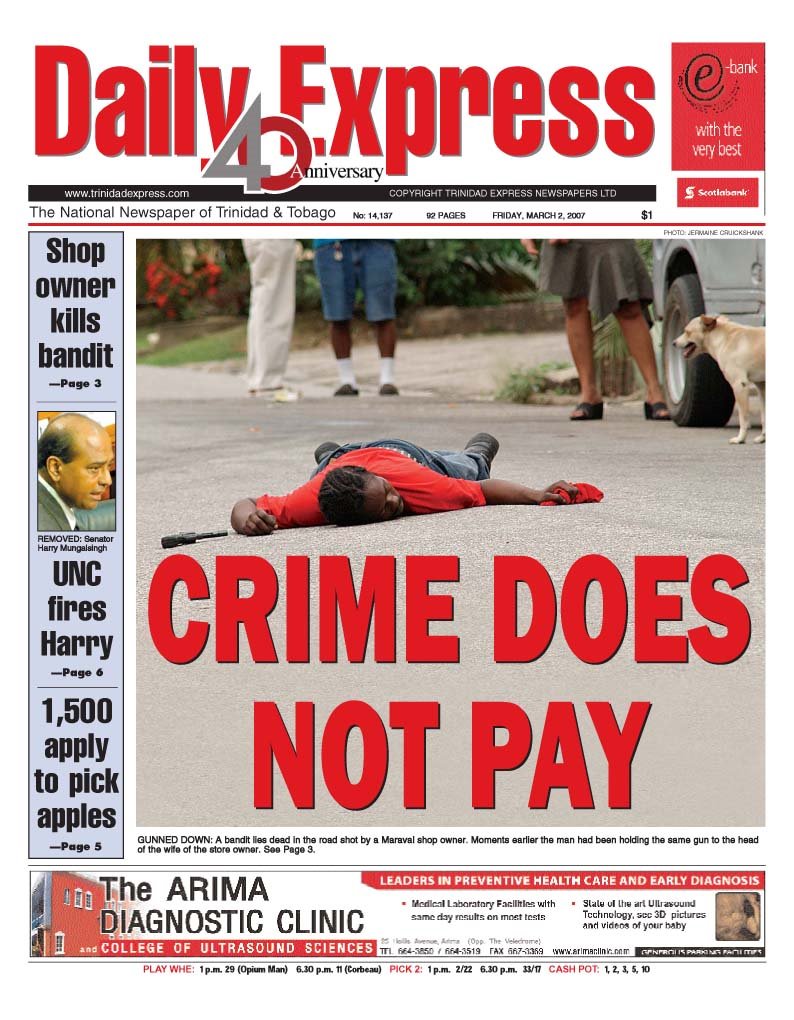
This is the front page you never saw in this morning's Trinidad Express.
For about 30 minutes last night this was the front page, complete with powerful picture, compelling headline and details of how this bandit was shot dead by the shop owner he tried to rob.
I'll admit that I was seduced by Jermaine Cruickshank's dramatic picture.
The way the gun has just fallen from his hand and how the dog is calmly going about his business.
But the unfortunate reality here is that bandits are shot regularly and our reporting of crime comes under public scrutiny on a daily basis. I just couldn't come up with a good enough answer as to why we should run it - save my base journalistic instincts just to use a good picture.
So: wise decision based on sound principles or a poor decision based on a lack of conviction? You decide.

Monday, December 18, 2006

In Freedom’s Name – The Great Indian Penis Debate

Editors spend most of their time trying to get stuff into the paper. Lawyers, politicians, businessmen, even lazy reporters conspire to ensure that things that should appear don’t get into the paper.
So, it was with a heavy heart that I ‘pulled’ a column that had been written for the comment pages of the Trinidad Express. It followed a study from the Indian Council of Medical Research which found that condoms made to international standards are too large for a majority of Indian men, or put another way, their penises are too small.
Cue much merriment in the column, which did indeed have its funnier moments.

“Indian men probably hope to dismiss the survey as, ‘No big thing!’ but the truth, as indubitable as it is irrational, is that penis dimensions have an importance to men way out of proportion to their size. In a quite literal sense, it really is no big thing.”

Here in the Trinidad there are about equal number of people from African and Indian descent, nearly 600,000 of each (the rest of us go into the ubiquitous ‘others’). To light this particular touch paper was just not something I wanted to do. There are many causes I would go into battle for, but the size of Indian men’s penises is not one of them.
The indignant writer – and I admire his indignation – asked me to appeal to some of the younger female staff for their views, which I duly did.

One wrote… –

“Well, what can I say? Firstly, I am horrified by the offensive nature of the column(definitely not funny). Secondly this is not something I think any of our readers would appreciate.”

Another… –

“*gasp* putting our hands in the hornet’s nest are we? This story would reach media-frenzy status! The idea was a great concept, but definitely not for the faint-hearted... it would only serve to spark and fuel much controversy.”

And another… –

“The column makes for fun, humourous reading for some. But we work in a newsroom and are educated and open minded enough to see where [he] is coming from and I’m one of his fans. There are many in Trinidad and Tobago who are offended at the slightest quips. Some of them illiterate and they would not find the column relayed by two or three people down a chain, adding their own salt and sugar perhaps, the least bit funny. I know for management’s bottom-line, they could already be pointing to massive advertising and readership fall-out.”


So, in the court of newsroom opinion, the column didn't run either.
Final word with the columnist: “In future you might see why I do so much in freedom’s name – don’t think I’m always right but do know how important it is in TT sometimes to err on the side of liberty.”

Freedom and liberty, now they are some big topics.


Friday, December 01, 2006

So farewell then to the Press Gazette

Sneaking a look at the editor’s Press Gazette (then UKPG) was one of the first of many newsroom dark arts learned at the knee of old hands who should have known better.
Now it is no more – maybe not for long according to latest reports – but I’m proud to publish this ode from PT Stodd, not to be confused with EJ Thribb, on its passing.

So farewell then to the Press Gazette
The hacks' neglected organ.
You seemed to chug along quite well
in the years before Piers Morgan.

After 40 years of obits
for subs from Slough to Chester
they're writing your obituary
for the want of a good investor.

So where to look now that you've gone
for jobs on Ilkley Moor?
And those ads for freelance writers
that smack of model, second floor.

We'll miss you dear old Press Gazette
and wish you all the best.
You lost your UK long ago
and now you've lost the rest.

PT Stodd
aged 62 and a week

Friday, November 24, 2006

Why sorry is still the hardest word

The lovingly crafted front page blurb – Rescuers find plane wreckage – directed readers to page 3 to find out the latest on a mysterious crash into the Caribbean Sea off St Vincent.
Sadly, as many smart-arse readers pointed out, the story wasn’t on page 3, in fact it wasn’t anywhere in the paper at all. While newsroom battles were being lost and won and the hurly-burly done, it just got left out. Simple as that. No excuses. Lots of people should and could have seen it was missing (including me) and no-one did.
Our newsroom inquest didn’t last long and it was time to own up. Trouble is, we don’t have a regular spot where apologies, clarifications and corrections can live, so it ended up tacked on the end of the follow-up story.

A question of redress
Our paper is huge, often up to 200 pages a day, so the opportunity for errors goes up in proportion. We have all the usual mistakes – factual errors, misquoting, bits left out etc etc - but currently nowhere in the paper to redress any of this.
It has prompted me to think seriously about starting somewhere in the paper where readers can point out errors, and indeed staff own up.
So I asked the granddaddy of corrections, Ian Mayes, Readers Editor at The Guardian in London for his advice. Specifically, I asked: What is the answer to internal critics who say that a column like this is just pointing out our own deficiencies and giving the opposition fuel for mockery?
Mayes replied: “There has been very little mockery of the Guardian's column
(not to confuse mockery with merriment at some of the funnier corrections).
I suspect that the main reason is that every journalist knows that mistakes are endemic. We all make them. As someone might have said, to err is human, to correct is, well if not divine, a very good thing.

Enhanced reputations
“Its acceptance by journalists at the Guardian is indicated by the number who now email or call into my office to say there's a mistake in my piece today etc. The
Guardian's experience is that trust is enhanced by carrying corrections columns. So
overall therefore is the reputation of the journalists.”
Mayes writes Open Door, a weekly column The Guardian, and is also president of the Organisation of News Ombudsmen. His daily columns are so celebrated they’ve been compiled into books.
I’m not sure I’ll ever get to the dizzy heights of ombudsman or book author, but I’m prepared to devise a column for saying sorry when we need to. Seems only fair.

Tuesday, November 14, 2006

The subs now leaving from...

As the proud owner of a number of mock-up leaving pages – including, ironically, one from the South China Morning Post – I read this story, Subs sacked over leaving page, in the MediaGuardian with both horror and fascination.
Maybe to have c**t not once, but twice, on the page wasn’t the brightest idea the two subs ever had but for the editor-in-chief to not only fire them but also send out a pompous email may also count as an, er, misjudgment.
As a fully paid-up member of the editor-in-chief club I always reckon its best to save your public bollockings, sorry b*********s, for something that really matters, aka something that affects readers.
To witter on about “there are basic standards of decency that need to be respected in any modern company, standards that are enshrined in our code of ethics” won’t do much for the good folk of Wan Chai or Chai Wan.
I for one hope the company sees fit to reinstate Messrs Ruffini and Willison; I’m sure their creativity can be put to good use in the pages of the SCMP.
PS: I had a miserable time there in the mid-80s; doesn’t seem like anything’s changed much.
PPS: Here is my latest leaving page (thanks again, Patrick), a lovingly produced one and only edition of The Geerdian. I love it and I’m sure the outgoing Sunday Post editor loves his too, c**ts and all.

Wednesday, November 08, 2006

When did you stop beating your wife?

No, it’s not a spoof, just one in a series of public information ads running in our paper.
Ironically, only last week at our training I introduced the famous ‘When did you stop beating your wife?’ question in a session about how to handle difficult interviewees.
Perhaps I’m cleverer than I thought. Then again…

Friday, November 03, 2006

Front, left and centre

Every editor loves doing the front page. It’s got nothing to do with budgets, staffing issues or defending editorial’s corner in a management meeting (however, as you probably know, I don’t do meetings, so let’s scrub that one). It’s just journalism; what we all came into this game to do.
Some days Page One sort of does itself. There’s an outstanding picture that’s going to leap out of the newsstands and a story that will have everyone chattering in the morning.
Some days – and I confess to probably liking these more – it’s more problematic. The things we’ve been planning all day simply haven’t come off; that great picture I’d drawn on the back of the morning news list just wasn’t there and even those staples that you squint at on a dry day (political bickering, sporting excellence) just don’t cut it.
We had one of those days yesterday.
11am
As I left the office for a couple of hours to do a session with some students at the University of the West Indies we had a tip that an 11-year-old boy had killed himself by drinking poison after being told off at school. Even in this lawless land, where life is cheap, that’s a story. The students asked me what would be on Page One tomorrow and when I related this tale there was a gasp in the room; ok, I thought, that’ll do me.
4.30pm
But come our afternoon news meeting nothing was clear. We had a pick-up picture of the boy and a picture of his grieving mum, but no story and no real idea of the strength of it. Other contenders were a talk with a mother pleading for her son not to be beaten up in prison (see yesterday’s post) and the West Indies getting to the final of the ICC Champions Trophy (that’s cricket, for you Americans out there). I’d been banking on a cricket pic, but they won so easily that it didn’t grab the nation like I’d hoped and picture editor Della pointed out that last time we went with cricket it didn’t go down very well. “I saw papers left on the stand,” she reported. For a paper that sells out every day that’s not good. We decided to hold off for an hour.
5.45pm
So, an hour closer to deadline we’re back having the same discussion, this time with the half a story that the reporter has so far written. Yes, he did drink poison and yes he is dead, as you are when you drink weedkiller lanate. However, he had a row with his brother over wearing a wristwatch and the school angle has faded away. But the reporter is anxious that we don’t go overboard on the suicide angle as it might give other youngsters the idea. News editor Curtis doesn’t think that’s much of an issue and design editor Barry is just itching to get going on the page, so we settle for
POISON
SUICIDE
OF BOY,11

but the bottom line is too long (yes, I know, it’s easy to see now) so we end up with what you see.
8pm
Back home I’m still not very happy about leading with a suicide. People jump under trains (not here, though, because there aren’t any) and fumigate themselves in cars every day and we carefully swerve past their private grief until they turn up at an inquest, where their lives are forensically examined for all to judge.
Carol, sensible as ever, adds more dimensions. Did he really mean to kill himself, or just frighten his family? Did he actually kill himself or was someone else involved? Did he know enough about what lanate can do to you?
3pm next day
A restless night later and now at mid-afternoon I’m feeling a bit better about it. My slap-in-the-face public barometer, our Trinidad Express website, has 50 comments and none of them criticizing our decision to publish. I’ve had no calls from outraged readers. My other man-in-the-street representative, editor-at-large Keith Smith, simply says: “It was never a lead story, happens all the time.”
Ho, hum…today’s another day.
PS: As if to add insult to injury the page didn't print properly either and we ended up with a yucky, low resolution, wobbly page. Aaaggghhh

Thursday, November 02, 2006

Words & Pictures


Use everything you have to tell the story. Think about the words and experiment with the best crop on the pictures.
I am determined to keep this story at the front of public consciousness. This boy must not die in vain.

Friday, June 02, 2006

Slow movers and fast workers in Vietnam

And so to Vietnam where I learn that dairy farmers worried about foot and mouth disease are turning to tortoise production (yes, for food) and am relieved that they know at least one more Englishman apart from Prince Charles and David Beckham.
Whether Gary Glitter is someone we’d all like as a symbol of Britishness in this far-flung country is another debate.
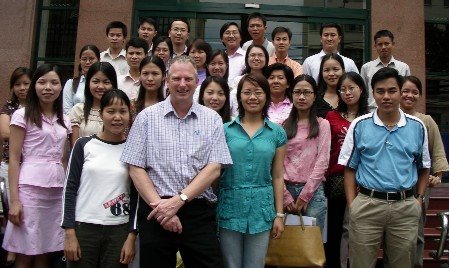
I’m here in Hanoi to run a four-day media management course (see picture above) and am rewarded with a handsome turnout of newspaper editors, trade magazine reporters and a delegation of people from a series of publications for ‘the youth’ – a phrase that always makes me shudder that Look and Learn is about to rise from the grave.
I shouldn’t have worried, though. One of the publications was a natty little handbag sized magazine for teenage girls and in between the advertisement for ringtones and language schools were glossy pin-up pictures, a readers’ forum, fashion and those pesky teenage problems that seem to be same the world over.
It couldn’t have been more different from the traditional daily paper that was selling 400,000 a day – “More than The Guardian” as the cheerful editor was quick to point out – but everyone worked hard together to see if they could take on board some of the latest developments in journalism and publishing.
The technological developments held no horrors for these talented, ambitious young people. Mobile phones are a cultural phenomenon, laptops the must-have accessory and swish cameras the must-to-be-seen-with gadget. My patient explanation of one-man video journalism started to look silly when one delegate showed me just that on his website.
It was therefore easy to forget that this is a one-party communist state operating under the traditional Party lines. But as things drew to a close and delegates reflected on what they might be able to implement back at base many talked about how they would find it difficult, if not impossible, to convince their bosses of what needs to be done.
Not for the first time doing this sort of project I reflected that probably the wrong people were on the course. These bright, lively, funny and ambitious young people only need pointing in the right direction by someone with enthusiasm and experience.
I’d love to think those poor tortoises are going to live for another day rather than the pot. Perhaps that’s not the only futile hope I have…