Friday, January 25, 2008
Why we love investigative journalism…


Lazy journalism, part 173
Fast forward to page 41: “Britain and Afghanistan fell out in spectacular fashion [yesterday] after President Karzai …” You get the idea. Whatever happened to the skill of the rewrite man?
Wednesday, December 12, 2007
The newspaper without a deadline
No sooner had I topped and tailed a round-up from the Eastern Counties League (RIP) and had a bacon roll and cup of tea from the trolley (also RIP) than the paper – damp and smelly, fresh from the press – was in my hand.
It was never much more than half and hour from sending the last story to getting a paper in your hand. It seemed a miracle then and it still seems a miracle today.
What made me think of this was a visit from Kevin Ward, editor of the Worcester News, who came in to talk to some first year journalism students. A better editor you couldn’t wish to meet: knowledgeable, committed, passionate and forward-thinking. But Kevin wrestles daily with a strange beast: a newspaper without a deadline. The Worcester News, previously known as The Worcester Evening News, is one of the new breed of morning evenings. It prints at 10.30 in the evening (I can’t bring myself to say night) and is on the news-stand with the nationals the next day.
That means that the 10am and 3pm conferences identify and then confirm the news of the day. The reporters, subs, photographers and even Albert the cleaner can all work towards an orderly conclusion in mid-evening before the press whirrs into action and spews the hard-fought fruits of the communal loins into, well, just the waiting vans.
Deadlines are the life-blood of newspapers. Even in this instant-web-based-news-environment we now inhabit there are still deadlines for newspapers to hit. For the Evenings it’s the remorseless change-up from far-flung districts to city centre and for Mornings it’s whatever we can change while the press is still running.
I’ve had run-ins with press room managers (“It’ll have fish and chips in it in the morning”), recalcitrant subs (“Do we have to change – it’s my break”) and circulations bods (“You’ll miss the van to Truro”) pulling out all the stops to get the latest and best into the paper.
I get the feeling that even extra-time in the Carling Cup might be as far as the Worcester News needs to go. Not much happens in the provinces after dark so the paper I buy at 9am is a reflection of what was happening in my community the afternoon before – full of those overnight pages we put together and hoped would get ousted by newer, and by definition more exciting, developments.
Don’t get me wrong: Kevin does a great job on his limited staff and even more limited investment from the Newsquest moguls. But an early evening deadline and morning distribution is a recipe for disaster.
Now, nearly 30 years on from when I was subbing at Cambridge, I still look at the clock at 10.45 – the first edition deadline for the back page – and hope the picture has been sent and the headline written. If not there’s always that block in my pocket and a quiet word with Nigel on the Ludlow…
Friday, October 19, 2007
Infographics: Why we love the 90s

 Hold up on those eulogies for the news graphic. Fleet Street may have long given up taking the time, trouble and effort to put together an informative words and pictures package – think ‘infographics’ of the 90s – but little brother Metro today shows the way.
A fascinating ‘Impact Science’ special compares the physical strains of rugby and formula one. It is well written with some amazing facts:
- During a scrum the spine can be subjected to 1.5 tonnes of pressure, equivalent to a medium sized rhinoceros
- During braking an F1 car can hit 5Gs – five times the force of gravity – making the driver five times his body weight.
OK, so some of the illustrations are a bit naff and the whole thing doesn’t get across the gutter very happily, but bravo to Metro and long may you carry on giving it a go.
Back in those 90s I was lucky enough to work with graphics journalist Duncan Mil who is still producing highly creative, imaginative graphics from his Graphic News studio in London.
At Thomson Regional Newspapers (RIP), editorial director Terry Quinn and I were convinced that graphics were the way forward. Some titles – notably Terry’s old stamping ground The Edinburgh Evening News and my old train set, The Journal in Newcastle – embraced the new marriage of words and pictures. But most others turned the other cheek and settled for refereeing newsdesk vs picture desk vs subs.
Most of those same papers are still reporting damp flats and stolen bikes – with far fewer readers and not a graphic in sight.
Don’t say I didn’t warn you…
Living up to George’s legacy
I loved my job as editor of the Kelowna Daily Courier in the glorious Okanagan Valley of British Columbia, Canada. Skiing in the winter; boating, golfing and the 19th hole in summer; an almost crime free environment and that genteel ‘no, after you’ society Canadians do so well –what wasn’t to like?
Trouble was, nothing much ever happened. The news editor would scramble together a daily news list that barely satisfied the appetite. We’d work hard to make not a lot out of nothing and hope the readers accepted it was them, not us, who wasn’t doing much. Twelve years later and I’m in Trinidad & Tobago having the opposite problem. There’s too much going on.
Murders, kidnaps, road deaths, government corruption and acts beastly and heroic – everything you’d have in a newspaper of your dreams, and more.
Our afternoon news list often bears little resemblance to its morning counterpart as so much breaking news has broken. My skills at making the most of what we’ve go honed back in Kelowna, are almost redundant. Stories guaranteed leads in thousands of newspapers around the world struggle to make it into our first 10 pages.
As I write, this week we’ve had a businessman abducted and found dead in a cane field with a plastic bag on his head, a woman killed in a car crash after swerving to avoid a jay-walking pedestrian and f
 our men murdered in one evening. None of these stories were on the front page.
The Readership Institute’s research on why people don’t buy newspapers listed “The paper makes me fearful” as one of the big turn-offs, and while we’re never going to sanitise the news or desensitise the reader we are mindful crime isn’t all there is to report. While I try to leave my so-called civilised world sensibilities behind it’s difficult to avoid drawing comparisons about the downright unfairness of life here.
A sad tale of an 11-year-old girl who drank poison at school because she was upset by bullying turned into a sordid story of incest, neglect and abuse. She lived in a cocoa-drying house with no water and electricity and was subjected to a torrid life almost beyond comprehension, unloved not just by her family but also by any kind of health or social service provision.
Meanwhile in the capital, Port of Spain, the finishing touches are being put to the newly-renovated Prime Minister’s residence. At TT$148 million it boasts a ‘diplomatic centre’ and enough bedrooms for all the cabinet to stay the night. Thirty minutes from the cocoa-drying house construction continues on the TT$275 million Brian Lara stadium and cricket academy at Tarouba. This was supposed to be ready for the Cricket World Cup in April and still isn’t much more than a big hole in the ground.
Patients sit for days in a hospital corridor because there are no beds. Children as young as five work openly in the markets because no one cares, or dares, to do anything about it.
All this makes me think about George John, a friend to journalism here in Trinidad & Tobago, the Caribbean and the Commonwealth. For 70 years he used the columns of many newspapers – including my own – to promote the joys of freedom and responsibility, cricket and calypso and almost everything else in between.
He died in March and a book of his writings has just come out, reminding me of the part I have to play in continuing his legacy. He reminds me of the 1997 Green Paper on Media Law Reform and its Draft Code of Ethics which the government of the day intended to impose on media reporting.
It read: “Journalists and newspapers should endeavour to highlight and promote activities of the State and the public which aim at national unity and solidarity, [and] integrity of Trinidad and Tobago, and economic and social progress.”
“Humbug to that,” said the thinkers of the day and the proposal died along with the aspirations of the UNC Government that lost the next election. Like much of the Commonwealth we continue to operate without any legislative framework save for one “Freedom of the Press” line enshrined in the constitution.
So we continue to govern ourselves, act responsibly when we feel like it and take pot-shots at politicians, businessmen and other inept and corrupt individuals who don’t fall into either category.
Coupled with this legislative free-for-all and buoyant news market is an almost complete lack of journalism education and training. People come and go through the gaping holes in the fences of the fourth estate, bringing bad habits and leaving a nasty smell.
But we’re doing our best to highlight the plight of the disadvantaged, call to account those who should be protecting them while also looking to our own industry by developing a proper internship scheme producing the well-rounded, robust journalists of tomorrow. George John, I hope, would approve.
Friday, June 29, 2007
First, second...and third with the news!

Thursday, May 24, 2007
We love you, turtles! Power of the positive

Funny how a creature that’s been around for 90 million years should stir up such a modern day controversy.
A simple story about how the amazing leatherback turtle is thriving off the coast of Trinidad blew up into a debate about the forces of good and evil and the part the media has to play is presenting ALL that happens in the community, not just the knee-jerk nasty.
“It is so good seeing the story on the turtles instead of crime. Please keep it up, we need more of these stories.”
“Ahh! That is such an uplifting story. Makes my heart sing. Thanks for making it the lead story.”
“At last, a positive and beautiful story coming out of our lovely island. Well done, Express, for placing it first. We’ve had enough with the crime.”
Just three of the comments posted on our website following the Sunday Express story on the turtles, which I had literally stumbled across the previous weekend on a trip to the remote northern coast.
The story and pictures not only struck a chord with readers at home and abroad but also reignited the debate about whether a national newspaper like the Express should be devoting its precious space to airing these stories when there is so much ‘important’ news around.
As if to illustrate my point, the following day the Trinidad Guardian, one of two daily rivals in the market here, ran as their front page ‘Weekend of Pain’. They lumped together two accidents, a shooting, a fire and a burial into one big celebration of negativity. Why not a ‘Weekend of Joy’? It would be just as easy.
The issues of news values and what to put in the paper are obviously something that exercise us every day. From early in the morning we ask: “What are readers talking about?” and “What can we get readers talking about?” as we strive for the right mix of timely information and enlightened entertainment.
Conspiring against running what detractors disparagingly call ‘feel-good stories’ is the sheer volume of breaking news and the manipulation of a relatively immature media market.
When you have a group of squatters calling a press conference – yes, that’s right, squatters had a press conference – timed to make it onto the lunchtime news; when you have a wanted man, who police say is armed and dangerous, surrendering live on the evening television news and when you have villagers protesting about the poor state of their roads waiting for the cameras to show up before they set fire to the barricades you know that the tail is well and truly wagging the dog.
News on prescription
Everyone has become a media manager and some sectors of the media have become complacently complicit in perpetuating this ‘news conspiracy’. Politicians, pressure groups, businesses and now even squatters will call up the media houses, who dutifully trot along to write down and film whatever they are told.
Whether the media people are over-worked, under-staffed, poorly-trained or just plain lazy the answer is just the same – the ‘prescription news’ is published and broadcast to the satisfaction of its creator and the media houses have copy to fill their newspapers and footage to pack their broadcasts.
And on the rare occasions when it doesn’t all go their way they take recourse to the letters column and even the lawyer’s office to seek redress. Only today I answered the phone to an indignant caller who berated me: “You didn’t publish my press release.” Well, that’s right, we didn’t and we’re not going to because it was bland, self-serving and of no value to our readers.
So, I like to reflect the positive things that are happening in our community and I suspect a lot of readers do too. I’ll also admit that I do have a bit of previous history in this area. When editor of the Tribune in Phoenix, Arizona I became so fed up with readers whinging about the downbeat news and staff failing to escape the news conspiracy that I designated the second Tuesday in July ‘Good News Day’.
The entire paper – news, sport, features, business – was given over to uplifting stories about the community and the people who lived in it. The issue created a furore with media watchers accusing me of censoring the news, staff grumbling because it was much more difficult to talk to real people rather than roll up to a news conference and the readers generally loving it.
Yes, of course we will still provide a daily snapshot of life in Trinidad & Tobago. And if that includes rape, kidnap, murder and other atrocities we will report them. It is not our job to sanitize the news.
Yes, of course we will still work hard to call to account our politicians and public officials. We invest a lot of resources into investigative journalism and will continue to do so.
But no, we won’t continue to slavishly follow a news agenda of crime, prescription news and things other people want you to read about.
The turtles have been doing their stuff for 90 million years. Long may they carry on doing it and long may we report it.
Let me know what you think.
Friday, March 02, 2007
The front page that never was
 This is the front page you never saw in this morning's Trinidad Express.
For about 30 minutes last night this was the front page, complete with powerful picture, compelling headline and details of how this bandit was shot dead by the shop owner he tried to rob.
I'll admit that I was seduced by Jermaine Cruickshank's dramatic picture.
The way the gun has just fallen from his hand and how the dog is calmly going about his business.
But the unfortunate reality here is that bandits are shot regularly and our reporting of crime comes under public scrutiny on a daily basis. I just couldn't come up with a good enough answer as to why we should run it - save my base journalistic instincts just to use a good picture.
So: wise decision based on sound principles or a poor decision based on a lack of conviction? You decide.
Monday, December 18, 2006
In Freedom’s Name – The Great Indian Penis Debate
So, it was with a heavy heart that I ‘pulled’ a column that had been written for the comment pages of the Trinidad Express. It followed a study from the Indian Council of Medical Research which found that condoms made to international standards are too large for a majority of Indian men, or put another way, their penises are too small.
Cue much merriment in the column, which did indeed have its funnier moments.
“Indian men probably hope to dismiss the survey as, ‘No big thing!’ but the truth, as indubitable as it is irrational, is that penis dimensions have an importance to men way out of proportion to their size. In a quite literal sense, it really is no big thing.”
Here in the Trinidad there are about equal number of people from African and Indian descent, nearly 600,000 of each (the rest of us go into the ubiquitous ‘others’). To light this particular touch paper was just not something I wanted to do. There are many causes I would go into battle for, but the size of Indian men’s penises is not one of them.
The indignant writer – and I admire his indignation – asked me to appeal to some of the younger female staff for their views, which I duly did.
One wrote… –
“Well, what can I say? Firstly, I am horrified by the offensive nature of the column(definitely not funny). Secondly this is not something I think any of our readers would appreciate.”
Another… –
“*gasp* putting our hands in the hornet’s nest are we? This story would reach media-frenzy status! The idea was a great concept, but definitely not for the faint-hearted... it would only serve to spark and fuel much controversy.”
And another… –
“The column makes for fun, humourous reading for some. But we work in a newsroom and are educated and open minded enough to see where [he] is coming from and I’m one of his fans. There are many in Trinidad and Tobago who are offended at the slightest quips. Some of them illiterate and they would not find the column relayed by two or three people down a chain, adding their own salt and sugar perhaps, the least bit funny. I know for management’s bottom-line, they could already be pointing to massive advertising and readership fall-out.”
So, in the court of newsroom opinion, the column didn't run either.
Final word with the columnist: “In future you might see why I do so much in freedom’s name – don’t think I’m always right but do know how important it is in TT sometimes to err on the side of liberty.”
Freedom and liberty, now they are some big topics.
Friday, December 01, 2006
So farewell then to the Press Gazette
Now it is no more – maybe not for long according to latest reports – but I’m proud to publish this ode from PT Stodd, not to be confused with EJ Thribb, on its passing.
So farewell then to the Press Gazette
The hacks' neglected organ.
You seemed to chug along quite well
in the years before Piers Morgan.
After 40 years of obits
for subs from Slough to Chester
they're writing your obituary
for the want of a good investor.
So where to look now that you've gone
for jobs on Ilkley Moor?
And those ads for freelance writers
that smack of model, second floor.
We'll miss you dear old Press Gazette
and wish you all the best.
You lost your UK long ago
and now you've lost the rest.
PT Stodd
aged 62 and a week
Friday, November 24, 2006
Why sorry is still the hardest word
Sadly, as many smart-arse readers pointed out, the story wasn’t on page 3, in fact it wasn’t anywhere in the paper at all. While newsroom battles were being lost and won and the hurly-burly done, it just got left out. Simple as that. No excuses. Lots of people should and could have seen it was missing (including me) and no-one did.
Our newsroom inquest didn’t last long and it was time to own up. Trouble is, we don’t have a regular spot where apologies, clarifications and corrections can live, so it ended up tacked on the end of the follow-up story.
It has prompted me to think seriously about starting somewhere in the paper where readers can point out errors, and indeed staff own up.
So I asked the granddaddy of corrections, Ian Mayes, Readers Editor at The Guardian in London for his advice. Specifically, I asked: What is the answer to internal critics who say that a column like this is just pointing out our own deficiencies and giving the opposition fuel for mockery?
Mayes replied: “There has been very little mockery of the Guardian's column
(not to confuse mockery with merriment at some of the funnier corrections).
I suspect that the main reason is that every journalist knows that mistakes are endemic. We all make them. As someone might have said, to err is human, to correct is, well if not divine, a very good thing.
Guardian's experience is that trust is enhanced by carrying corrections columns. So
overall therefore is the reputation of the journalists.”
Mayes writes Open Door, a weekly column The Guardian, and is also president of the Organisation of News Ombudsmen. His daily columns are so celebrated they’ve been compiled into books.
I’m not sure I’ll ever get to the dizzy heights of ombudsman or book author, but I’m prepared to devise a column for saying sorry when we need to. Seems only fair.
Tuesday, November 14, 2006
The subs now leaving from...
 As the proud owner of a number of mock-up leaving pages – including, ironically, one from the South China Morning Post – I read this story, Subs sacked over leaving page, in the MediaGuardian with both horror and fascination.
Maybe to have c**t not once, but twice, on the page wasn’t the brightest idea the two subs ever had but for the editor-in-chief to not only fire them but also send out a pompous email may also count as an, er, misjudgment.
As a fully paid-up member of the editor-in-chief club I always reckon its best to save your public bollockings, sorry b*********s, for something that really matters, aka something that affects readers.
To witter on about “there are basic standards of decency that need to be respected in any modern company, standards that are enshrined in our code of ethics” won’t do much f
 or the good folk of Wan Chai or Chai Wan.
I for one hope the company sees fit to reinstate Messrs Ruffini and Willison; I’m sure their creativity can be put to good use in the pages of the SCMP.
PS: I had a miserable time there in the mid-80s; doesn’t seem like anything’s changed much.
PPS: Here is my latest leaving page (thanks again, Patrick), a lovingly produced one and only edition of The Geerdian. I love it and I’m sure the outgoing Sunday Post editor loves his too, c**ts and all.
Wednesday, November 08, 2006
When did you stop beating your wife?
 No, it’s not a spoof, just one in a series of public information ads running in our paper.
Ironically, only last week at our training I introduced the famous ‘When did you stop beating your wife?’ question in a session about how to handle difficult interviewees.
Perhaps I’m cleverer than I thought. Then again…
Friday, November 03, 2006
Front, left and centre
 Every editor loves doing the front page. It’s got nothing to do with budgets, staffing issues or defending editorial’s corner in a management meeting (however, as you probably know, I don’t do meetings, so let’s scrub that one). It’s just journalism; what we all came into this game to do.
Some days Page One sort of does itself. There’s an outstanding picture that’s going to leap out of the newsstands and a story that will have everyone chattering in the morning.
Some days – and I confess to probably liking these more – it’s more problematic. The things we’ve been planning all day simply haven’t come off; that great picture I’d drawn on the back of the morning news list just wasn’t there and even those staples that you squint at on a dry day (political bickering, sporting excellence) just don’t cut it.
We had one of those days yesterday.
11am
As I left the office for a couple of hours to do a session with some students at the University of the West Indies we had a tip that an 11-year-old boy had killed himself by drinking poison after being told off at school. Even in this lawless land, where life is cheap, that’s a story. The students asked me what would be on Page One tomorrow and when I related this tale there was a gasp in the room; ok, I thought, that’ll do me.
4.30pm
But come our afternoon news meeting nothing was clear. We had a pick-up picture of the boy and a picture of his grieving mum, but no story and no real idea of the strength of it. Other contenders were a talk with a mother pleading for her son not to be beaten up in prison (see yesterday’s post) and the West Indies getting to the final of the ICC Champions Trophy (that’s cricket, for you Americans out there). I’d been banking on a cricket pic, but they won so easily that it didn’t grab the nation like I’d hoped and picture editor Della pointed out that last time we went with cricket it didn’t go down very well. “I saw papers left on the stand,” she reported. For a paper that sells out every day that’s not good. We decided to hold off for an hour.
5.45pm
So, an hour closer to deadline we’re back having the same discussion, this time with the half a story that the reporter has so far written. Yes, he did drink poison and yes he is dead, as you are when you drink weedkiller lanate. However, he had a row with his brother over wearing a wristwatch and the school angle has faded away. But the reporter is anxious that we don’t go overboard on the suicide angle as it might give other youngsters the idea. News editor Curtis doesn’t think that’s much of an issue and design editor Barry is just itching to get going on the page, so we settle for
POISON
SUICIDE
OF BOY,11
but the bottom line is too long (yes, I know, it’s easy to see now) so we end up with what you see.
8pm
Back home I’m still not very happy about leading with a suicide. People jump under trains (not here, though, because there aren’t any) and fumigate themselves in cars every day and we carefully swerve past their private grief until they turn up at an inquest, where their lives are forensically examined for all to judge.
Carol, sensible as ever, adds more dimensions. Did he really mean to kill himself, or just frighten his family? Did he actually kill himself or was someone else involved? Did he know enough about what lanate can do to you?
3pm next day
A restless night later and now at mid-afternoon I’m feeling a bit better about it. My slap-in-the-face public barometer, our Trinidad Express website, has 50 comments and none of them criticizing our decision to publish. I’ve had no calls from outraged readers. My other man-in-the-street representative, editor-at-large Keith Smith, simply says: “It was never a lead story, happens all the time.”
Ho, hum…today’s another day.
PS: As if to add insult to injury the page didn't print properly either and we ended up with a yucky, low resolution, wobbly page. Aaaggghhh
Thursday, November 02, 2006
Words & Pictures


Use everything you have to tell the story. Think about the words and experiment with the best crop on the pictures.
I am determined to keep this story at the front of public consciousness. This boy must not die in vain.
Friday, June 02, 2006
Slow movers and fast workers in Vietnam
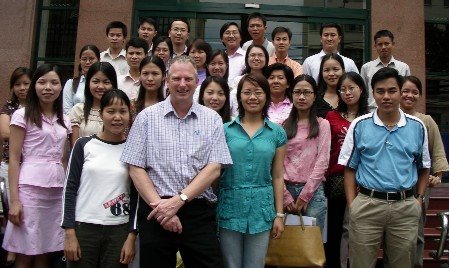 And so to Vietnam where I learn that dairy farmers worried about foot and mouth disease are turning to tortoise production (yes, for food) and am relieved that they know at least one more Englishman apart from Prince Charles and David Beckham.
Whether Gary Glitter is someone we’d all like as a symbol of Britishness in this far-flung country is another debate.
I’m here in Hanoi to run a four-day media management course (see picture above) and am rewarded with a handsome turnout of newspaper editors, trade magazine reporters and a delegation of people from a series of publications for ‘the youth’ – a phrase that always makes me shudder that Look and Learn is about to rise from the grave.
I shouldn’t have worried, though. One of the publications was a natty little handbag sized magazine for teenage girls and in between the advertisement for ringtones and language schools were glossy pin-up pictures, a readers’ forum, fashion and those pesky teenage problems that seem to be same the world over.
It couldn’t have been more different from the traditional daily paper that was selling 400,000 a day – “More than The Guardian” as the cheerful editor was quick to point out – but everyone worked hard together to see if they could take on board some of the latest developments in journalism and publishing.
The technological developments held no horrors for these talented, ambitious young people. Mobile phones are a cultural phenomenon, laptops the must-have accessory and swish cameras the must-to-be-seen-with gadget. My patient explanation of one-man video journalism started to look silly when one delegate showed me just that on his website.
It was therefore easy to forget that this is a one-party communist state operating under the traditional Party lines. But as things drew to a close and delegates reflected on what they might be able to implement back at base many talked about how they would find it difficult, if not impossible, to convince their bosses of what needs to be done.
Not for the first time doing this sort of project I reflected that probably the wrong people were on the course. These bright, lively, funny and ambitious young people only need pointing in the right direction by someone with enthusiasm and experience.
I’d love to think those poor tortoises are going to live for another day rather than the pot. Perhaps that’s not the only futile hope I have…
Saturday, March 25, 2006
Why Murdoch is getting sniffy
 When Rupert Murdoch starts to sniff, either with emotion or because he thinks he’s going down with something, there’s a good chance everyone else is catching a cold.
Twice in the last year the world’s most powerful media owner has shown a softer side by admitting that he’s got it wrong and urged communications companies to wake up to the threats and challenges of the new media age.
Calling the current testing times “the dawn of a golden age of information – an empire of new knowledge” Murdoch told a London audience this month (March 2006) that power is moving away from those who own and manage the media to a new and demanding generation of consumers.
Giving a vote of confidence to robust journalism he said that “never has the flow on information and ideas, of hard news and reasoned comment, been more important.”
The chief executive of News Corporation told the Worshipful Company of Stationers and Newspaper Makers: “The challenge for us in the traditional media is how to engage with this new audience. There is only one way. That is by using our skills to create and distribute dynamic, exciting content.”
The new audience is, of course, that elusive internet generation. People who do not buy traditional media, like newspapers, but rely on information on demand from the web, mobile phones or other forms of electronic delivery.
Just last April Murdoch shocked the industry by revealing that “many of us have been remarkably, unaccountably complacent” about the challenge from internet delivered media. “Certainly, I didn’t do as much as I should have after all the excitement of the late 1990s,” he told the American Society of Newspaper Editors.
He called for a complete transformation of the way we think about the product. “Unfortunately, however, I believe too many editors and reporters are out of touch with our readers. Too often, the question we ask is ‘Do we have the story? rather than “Does anyone want the story?’”
Murdoch put his money where his mouth is last year by splashing out $400m on MySpace.com, a virtual ‘networking’ site where 35 million regular users talk about music, film travel etc and share pictures, videos and their innermost blog thoughts.
But what about the unholy alliance of these newly-enfranchised one-person media outlets with the traditional players? Will there be room for words and pictures generated outside the strictures of the old newsroom culture.
The Daily Telegraph, Britain’s best-selling ‘serious’ daily trumpeted, “a brilliant new way to be part of the paper”.
The gushing copy said: “Have you ever found yourself in the midst of a major news story and wanted to share it with others? Now that so many people have mobile phones with cameras, the possibility exists for us all to contribute to the news agenda.”
Easy as that. Take a snap, send it in, see it on the website or in the paper and everybody’s happy. Well, not quite…
Cue wailing and gnashing from the both the National Union of Journalists and the Chartered Institute of Journalists citing legal and copyright issues plus the perennial protection of “the jobs of professionals in the industry”.
If this predictable po-faced attitude is supposed to put the frighteners on people who want be part of the paper rather than be lectured at then there’s bad news from markets around the world.
The South Korean site Ohmynews – http://english.ohmynews.com/ – has nearly 40,000 citizen reporters on its books who submit content on just about everything with little or no interference from the so-called professional journalists back in the office. Along with this huge workforce of eyes and ears come lots of potential customers too. Last year it turned in a profit of $400,000, two thirds of it from advertising.
Then there is Scoopt, which gives the ‘photographer’ half of the proceeds of pictures they sell and Spy Media, the ‘News Photo Marketplace for Everyone’.
There are plenty of yucky names out there for this. ‘Citizen journalism’ seems flavour of the month along with ‘personal’, ‘individual’, ‘participatory’, or ‘grassroots’ media and even ‘user-generated content’ (UGC), which would no doubt impress the accountants.
The issue has exercised the venerable Poynter Institute based in Miami who worry that the “citizen journalism” label seems to imply that professional journalists are not citizens, rather than what's really meant: “citizens practising amateur journalism”.
But what does all this mean for sales and readership?
Online guru Jeff Jarvis is plain in his assertion that no one owns journalism. “It is not an official act, a certified act, an expert act, a proprietary act. Anyone can do journalism. Everyone does. Some do it better than others of course. But everyone does it” he says.
And like the threat of the internet on classified advertising the whole issue of citizen journalism could soon start to exercise the major media players. The parallels are clear. Just as Trinity Mirror and the Daily Mail have spent millions buying up internet advertising sites soon they may look towards consolidating content that appears on the web.Then the future does start to look very different for our beleaguered national newspapers.
Sunday, March 05, 2006
Famous faces, empty heads
 The Observer’s Eddie Butler – who is also, of course, the BBC’s Eddie Butler – reveals how nearly an entire XV of former greats lined up to contribute to Wales’s public relations downfall. Gwyn Jones, Rupert ‘don’t ask me why I’m here’ Moon and the ‘lying’ chairman David Pickering might know more about what happens on the pitch than us mere mortals but they haven’t got a clue when it comes to either communicating what they know or getting other people to open up.
It is one short hop from ex-international to PR hanger-on or TV talking-head. Television has always been generous in providing a gracious get-out for fading sports stars, but most of them are woeful.
The BBC’s rugby coverage now resembles Jeff Stelling’s home for retired soccerfolk on Sky Soccer Saturday. Yes, you’re right, Brian, we don’t know what happens in the front row – we’re hoping you’re going to tell us. Thanks, Austin, we can see also see a man with a bandage on his head – but is it serious?
There’s a grand tradition of Welsh sportsmen – think Cliff Morgan, Wilf Wooller and Tony Lewis – playing a greater part in a wider world. This current lot either need to go back to school and learn some new tricks for their new trade or go back to reliving their past glories in private.
Alan Geere
Sport and The Media Research Unit
University of Westminster
Tuesday, February 07, 2006
State of The American Newspaper
 By William Prochnau, a former national reporter for the Washington Post, is a contributing editor of Vanity Fair and Pulitzer Prize winner
….Alan Geere is also British. Garner's paladin, he is a self-described hired gun brought in to get the Mesa operation up and moving aggressively in its suburban war against the Arizona Republic. An immensely joyous man, he runs on a mix of adrenaline and ideas, good and bad, both of which will become yesterday's news without cheers or tears, a new set having by then erupted. He is here until December 31, 1999, when his work visa expires. His only regret after a year in the U.S. is that people find him intimidating. (“Everywhere I go I am surrounded by a sea of mildly antagonistic faces,” he tells me.)
Now he exults about his Mesa experience: “We have fun day and night! We're not wrapped up in winning awards! We used to be a fancy-pants newspaper that tried to be like the Washington Post.” But no more, he says. “I don't want to be a guiding light for society.” Recently, he sent a young reporter out to interview moviegoers emerging from the political satire “Wag the Dog.” All went well until an elderly man, three times the interviewer's age, began chasing the reporter down the street, scolding, “You're the problem! You're the problem!”
Full story:
http://www.ajr.org/Article.asp?id=3285
Sunday, February 05, 2006
The future’s not black and white
 Richard Burton, editor of telegraph.co.uk, looks at the perils and advantages of reporting online and how new technology is changing the media.
…Alan Geere, head of the London-based Journalism Training Centre, was quoted in the hack's magazine, Press Gazette, criticising regional newspapers for their “old fashioned, one dimensional, institutional reporting” and slams their “cavalier disregard for readers who don't seem to matter. No wonder they're not buying papers any more”.
Never one to mince his words, he goes on to cite such new media success stories as Ohmynews as placing tanks on the lawn of the press and even suggests newspapers scrap their offices altogether.
He’s told me since he expects fewer Christmas cards this year but that may be mildly prophetic, given the number of job cuts the same magazine reports every week….